LS2 FF901 Advant X Carbon Future II White Blue – Flip-Up Touring Helmet ECE 22.06 P/J
Prices for Portugal include VAT · Shipping calculated at checkout
Inside the EU — no customs duties will apply.
Questions? Just reach out — our team will help you right away.
Size chart LS2 FF901
| Size | Head circumference (cm) | Head circumference (inch) |
|---|---|---|
| XS | 53–54 cm | 20.9–21.3 in |
| S | 55–56 cm | 21.7–22.0 in |
| M | 57–58 cm | 22.4–22.8 in |
| L | 59–60 cm | 23.2–23.6 in |
| XL | 61–62 cm | 24.0–24.4 in |
| XXL | 63–64 cm | 24.8–25.2 in |
| 3XL | 65–66 cm | 25.6–26.0 in |

How to measure your helmet size correctly: To find the right helmet size, measure your head circumference with a flexible tape measure.
It is important that the tape measure runs around the widest part of the head – only then will you get a correct result.
Place the tape measure at the front, about 1–2 cm above the eyebrows, and run it along the sides above the ears.
At the back, the tape must run over the largest part of the back of the head (not too low on the neck). The tape may run slightly at an angle – what matters is that it sits all the way around the largest points of the head.
Make sure the tape measure sits snugly but does not dig in. Measure 2–3 times for the most accurate result. You can then compare the measured value in centimetres (cm) with our size chart.
Tips for an accurate result
- Keep hair flat (e.g. do not measure over a voluminous hairstyle)
- Keep the tape horizontal, i.e. along the largest circumference
- Do not measure too loosely
- For values between two sizes:
→ usually choose the larger size (depending on helmet model / fit)
Important note on fit
The right helmet should fit firmly without causing uncomfortable pressure points.
A new helmet may feel a little tighter at first, as the inner lining adapts slightly over time.
- Worldwide shipping
- Genuine parts & verified quality
- Personal email support
- 14-day returns — in stock ships within 24h
Shipping & Returns
We ship with DHL and FedEx — express on request. If an item is in stock, express delivery can often go out within 1 business day. Standard delivery takes about 2–5 business days domestically and usually around a week worldwide. Please check the available shipping options and delivery times in your cart, as we offer several carriers depending on the country.
Returns must be registered in advance by email and are possible in line with our cancellation policy (14-day return request + 14-day return window after approval). Please note: unregistered returns are not accepted. You'll find all details on conditions, exceptions and refunds in our cancellation policy.
Payment & Security
Payment methods
Your payment information is processed securely. We do not store credit card details and have no access to your credit card information.
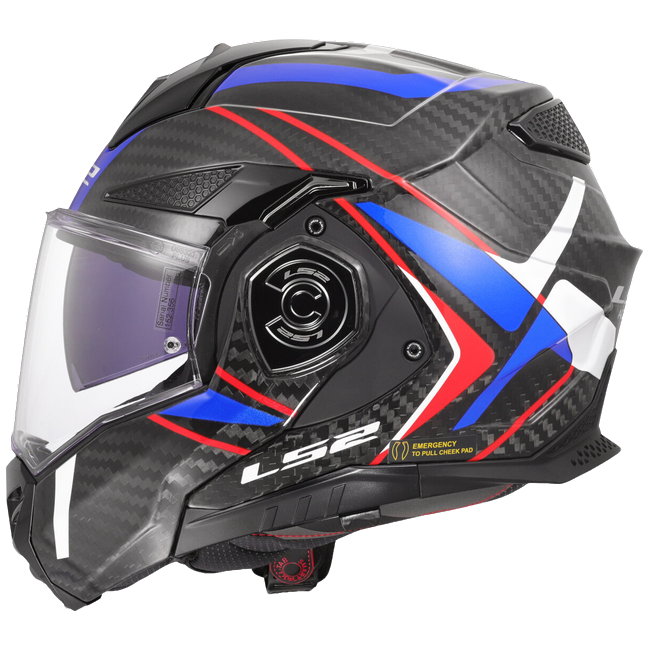
Future II is the angular one — hard-edged facets in white and deep blue breaking across the sides of the shell, with sections of the carbon weave deliberately left bare between them. Where the panels stop, the material starts, and the transitions are where this graphic earns its money.
The chin bar that folds out of the airstream
Look at the back of this helmet rather than the front. That flush, low section behind the ears is where the chin bar lives when it is open — a full 180 degrees of rotation, not the 90-or-so degrees that leaves most modular chin bars standing on the crown like a spoiler nobody asked for. The geometry is the point: air arriving at 100 km/h finds a helmet-shaped helmet instead of a step.
Riders who have owned a conventional flip-up will recognise what that fixes. No lift under braking, no low-frequency drumming, no sensation of the helmet trying to rotate backwards off your head. Carbon construction keeps the swinging mass down, and the detented release means the bar stays exactly where you leave it — open, closed, and nowhere in between.
P and J: one helmet, two homologations
The homologation label reads ECE 22.06 P/J, and the two letters are the reason you may legally ride with this helmet open. P is the protective classification — the chin bar has been impact-tested and counts as protection. J is the jet classification: with the bar rotated away, the helmet has separately passed the standard as an open-face lid. Both approvals sit on the same label, which is what "dual homologation" means.
Plenty of modular helmets carry only P. Those are legal to ride only with the chin bar closed; opening one in motion puts you outside the approval it was sold under, whatever the police in a given country do about it in practice. A P/J helmet removes the question entirely. It also means the chin bar was tested as a load-bearing structure rather than as a wind deflector — the standard measures whether it stays locked under impact, and the result is part of the certification rather than a marketing claim.
About the Future II White Blue finish
The Future II pattern is built from straight-edged planes rather than curves, and the white-and-blue arrangement is the version that gives it the most contrast. White carries the leading facets around the brow and the chin bar, deep blue fills the flanks and the rear, and between them the bare 6K twill shows through under gloss lacquer — not as a background, but as a third colour with a texture of its own. Because it is glossed rather than matted, the facet edges stay razor-sharp; a matt coat would soften exactly the boundaries the design depends on. Blue over white is also one of the more visible combinations here in daylight and dusk alike, and the white sections keep the helmet cooler in stationary traffic than any of the dark options. It is the most overtly modern of the six, and the one that most obviously does not look like a touring helmet.
Carbon 6K — chin bar included
100 % carbon, and the phrase is used precisely: the shell and the chin bar are both carbon 6K, laid up rather than injection-moulded. That is a more expensive way to make a chin bar and a more difficult one, because the bar is a compound curve with a locking mechanism buried in it. Most manufacturers use plastic there and put carbon only where it is visible.
Carbon earns its price in stiffness per gram. A stiffer shell spreads an impact across more of the EPS instead of concentrating it, and a lighter one puts less load through your neck over a long day. On a modular helmet — which starts life heavier than a full-face because of the mechanism — that combination is worth more than it is on a plain lid.
What SHARP found, and why we are not claiming it
Independent testing: none for this exact helmet, and we would rather say so plainly than leave you to assume otherwise. What exists is a SHARP four-star rating for the composite-shell Advant X, tested July 2024 against ECE 22.06 — five out of five in every zone at 6.0 and 7.5 m/s, three at the sides at 8.5 m/s, chin bar fully locked in 63 % of impacts. Strong numbers, and genuinely useful context for the model family.
But SHARP tested a 1.6 kg composite-fibre helmet, and this is a 1550 g carbon one. We have made the mistake of transferring a rating across shell variants before and it is not one we intend to repeat, so the safety-test field on this product stays empty. What this helmet does carry is ECE 22.06 with dual P/J homologation, which is a full laboratory certification in its own right — just not a comparative rating. We stock that helmet: it is the LS2 FF901 Advant X in HPFC composite, same chin bar, same P/J approval, 50 g heavier and 70 € cheaper — and it is the one carrying the stars.
What the ECE 22.06 plaque actually means
Worth a paragraph, because most shops leave it as a line in a table. ECE 22.06 tests up to eighteen impact points where 22.05 tested five, uses more than one impact speed, and — the substantive change — measures rotational acceleration through an oblique drop onto an angled, abrasive anvil.
Straight-line impact was always the easier problem. Rotation is what a real crash usually delivers, and it is what damages the brain at energies a shell survives comfortably. The standard also brings the visor and every fitted accessory into the test, and has been mandatory for new helmets sold in the EU since January 2024.
Getting the helmet off a fallen rider
Two features here exist for other people's benefit. The first is the emergency release system: red tabs at the base of the cheek pads let a first responder pull the padding out sideways, so the helmet lifts away from your head instead of being dragged over a neck that may be injured. Ambulance crews are trained to do exactly this, and most helmets do not let them.
The second is the retention system — a micrometric buckle with a metal ratchet, not a plastic one. Set the strap length once and every ride afterwards is one click in and one pull out, with gloves on, in the dark. Metal matters here because the ratchet teeth are the part that takes the load, and because a metal buckle does not creep out of adjustment over a season. The strap itself is reinforced, and the certification plaque is riveted to it.
Three screens, one shell
The Twin Visor System is LS2's name for running two screens on one shell, and the Advant X ships with a third in the box. The outer visor is hardcoated against scratches, UV-stable and cut wide, and it changes without tools. Inside the shell, a tinted sun visor drops on a slider and retracts fully out of the way. In the carrying backpack you will find a complete second outer visor, already tinted.
Fitted to the clear screen is a Pinlock 120 MaxVision XLT anti-fog insert. Pinlock grades its lenses by how much water vapour they hold before they give up; 120 is the top grade, and MaxVision is the wide cut that does not leave a visible frame across your field of view. Buying all of that separately would add a meaningful fraction of the helmet's price.
In at two ends, out at the back
Two intakes, ducted EPS, one exhaust, one breath deflector. The chin vent is adjustable and points at the inside of the visor and your face; the top vent feeds channels cut through the polystyrene; the rear exhaust port pulls the warmed air out. It is a complete circuit rather than a set of openings, and on a helmet with a sun-visor housing eating into the space above your forehead, that routing is what keeps the airflow working.
Realistic expectations: no flip-up ventilates like a vented sports helmet, because the mechanism occupies volume that would otherwise be liner and duct. What this system does well is the touring case — steady airflow at road speed, a visor that stays clear in cold weather, and the option of simply rotating the chin bar away when you are stopped in summer traffic.
Fit, and the honest word on two shells
XS to 3XL, two shells: one covering XS through L, one covering XL through 3XL. That is the specification and here is the honest reading of it. A two-shell range means the smallest sizes sit inside a shell designed around a larger head, with thicker EPS taking up the slack — safe and certified, but visually a size up and a few grams heavier than a dedicated small shell.
Nearly every premium flip-up does the same thing, because a modular shell carries the pivot, the latch and the sun-visor housing as moulded-in geometry. Three shells would mean three of those tools. The trade LS2 made was to put the money into carbon 6K instead, shell and chin bar alike. For M, L and XL riders that is unambiguously the better bargain; for an XS it is worth a fitting first.
X-Static silver, and laser-cut foam
Everything that touches your head comes out, washes and goes back in. The fabric carries an X-Static silver treatment, which is antibacterial because silver is antibacterial — no chemistry that wears off — and the foam behind it is laser-cut rather than die-cut, which lets its density and profile change across a single pad.
Practical consequences over a year of use: the helmet does not develop the smell that eventually makes riders replace an otherwise sound lid, and the padding holds its shape at the points that matter for stability. And when the interior does eventually compress — every liner does — it is a replaceable part rather than a reason to buy a new helmet.
Before you buy an intercom
Before you order a communicator, read this. The Advant X takes its intercom by adhesive mount only — there is no clamp slot between the shell and the cheek pad. That is an LS2 specification, not an oversight, and it is the normal consequence of a carbon shell: a clamp recess means a deliberate gap in the laminate, and on carbon that is a place you would rather not create.
What the helmet does provide is proper preparation: shaped speaker pockets in the EPS, a routing channel for the loom, and a flat, clean area on the shell for the base plate. Fit is straightforward, it is simply permanent. Dry-fit the unit with the helmet on your head first to check the button reaches your thumb, degrease the shell with isopropyl alcohol, then bond it and leave it overnight. Done once, properly, it is a better mount than most clamps.
On noise
Wind noise is the specification manufacturers never quote, because it depends more on your bike than on their helmet. What the helmet controls is the seal at the neck roll, the gap under the chin bar and the vents. A chin curtain is fitted as standard, and it is the single most effective piece of quiet in the box — provided it stays in the helmet after you clean it. The chin bar rotating fully to the rear helps here: a modular bar parked on the crown sits in clean air and drums, while one lying behind the head does not.
What it does not control is the airflow leaving your screen. If a helmet is loud on one motorcycle and quiet on another, the screen is usually the reason. Plugs cost a euro and do more than any shell shape.
1550 grams on a flip-up
1550 grams, ±50, taken the way the industry takes it: a mid-size shell with nothing added. Read that number against other flip-ups rather than against full-face helmets — a modular carries a hinge, a latch, a second visor and a certified chin bar, and the premium touring flip-ups that riders cross-shop this against generally sit between 1650 and 1800 grams.
It is also 50 grams lighter than our lightest fibreglass full-face touring helmet, which for a P/J modular is genuinely unusual. Weight is the specification riders under-rate in a showroom and over-rate at the end of a four-hour stint: a head weighs about five kilos, the helmet adds roughly a third again, and every expansion joint on the motorway multiplies the lot through your neck.
Where it sits in our LS2 range
This is the only flip-up in our LS2 line-up, so the comparison below is deliberately cross-type: it shows what the same money buys as a full-face, and what the folding chin bar costs in weight and price. Set against the FF811 Vector II Carbon — same carbon 6K, same manufacturer, 150 grams lighter — the Advant X asks 90 euros more for a chin bar that moves and a second homologation.
| Model | Type | Shell | Weight | RRP |
|---|---|---|---|---|
| FF817 Challenger II | Full-face | HPFC | 1500 g | from 329 € |
| FF811 Vector II Carbon | Full-face | Carbon 6K | 1400 g | from 379 € |
| FF901 Advant X (HPFC) | Flip-up (P/J) | HPFC | 1600 g | from 399 € |
| FF901 Advant X Carbon | Flip-up (P/J) | Carbon 6K | 1550 g | from 469 € |
| FF807 Dragon | Full-face | Carbon 6K | 1450 g | from 479 € |
| FF805 Thunder | Full-face | Carbon | 1280 g | from 599 € |
When something wears out
Worth knowing before you buy rather than after: everything on this helmet that wears out can be replaced individually. Liners in all seven sizes cheek pads in several thicknesses, six replacement visors from clear through to iridium gold, the tinted sun visor and its mechanism, the carbon chin curtain, complete replacement chin bars in every colourway, the chin-bar ratchet system, pins, plates and chin, top and rear vents in matt or gloss black.
The interior is the part that decides how long the helmet stays honest. Sweat and hair oils break down the foam, the fit loosens, and riders conclude the helmet is finished when the shell is untouched. The full parts list is in the FF901 Advant X Kit.
In the box
- LS2 FF901 Advant X Carbon helmet — Future II White Blue
- Carrying backpack
- Tinted visor
- Pinlock® 120 MaxVision™ XLT anti-fog insert (DKS433)
- Reflective stickers
Specification
- Model — LS2 FF901 Advant X Carbon
- Part number — 569015602
- Colour — Future II White Blue — Future II graphic, gloss white and blue over carbon
- Homologation — ECE 22.06, dual P/J (protective and jet)
- Helmet type — Flip-up / modular, chin bar rotating 180° to the rear
- Shell — Carbon 6K, chin bar in carbon as well, two shell sizes (XS–L / XL–3XL)
- Weight — 1550 g (±50 g)
- Sizes — XS to 3XL (seven sizes)
- Visor — Twin Visor System, scratch-resistant, UV-stable, quick-release; tinted second visor supplied
- Anti-fog — Pinlock® 120 MaxVision™ XLT (DKS433) supplied
- Sun visor — integrated, tinted, drop-down
- Impact liner — multi-density EPS with moulded ventilation channels
- Retention — micrometric metal buckle, reinforced chin strap, emergency release system
- Ventilation — chin intake, top intake, rear exhaust port, breath deflector
- Liner — X-Static© silver antibacterial, laser-cut foam, hypoallergenic, breathable, removable and washable
- Intercom — prepared for the LS2 intercom — adhesive mount only, no clamp slot
| Model | LS2 FF901 Advant X Carbon |
|---|---|
| Part number | 569015602 |
| Colour | Future II White Blue — Future II graphic, gloss white and blue over carbon |
| Homologation | ECE 22.06, dual P/J (protective and jet) |
| Helmet type | Flip-up / modular, chin bar rotating 180° to the rear |
| Shell | Carbon 6K, chin bar in carbon as well, two shell sizes (XS–L / XL–3XL) |
| Weight | 1550 g (±50 g) |
| Sizes | XS to 3XL (seven sizes) |
| Visor | Twin Visor System, scratch-resistant, UV-stable, quick-release; tinted second visor supplied |
| Anti-fog | Pinlock® 120 MaxVision™ XLT (DKS433) supplied |
Fitment data coming soon.
No reviews yet.
// LS2
LS2 FF901 Advant X Carbon Future II White Blue – Flip-Up Touring Helmet ECE 22.06 P/J
Tech specs
- Model
- LS2 FF901 Advant X Carbon
- Part number
- 569015602
- Colour
- Future II White Blue — Future II graphic, gloss white and blue over carbon
- Homologation
- ECE 22.06, dual P/J (protective and jet)
- Helmet type
- Flip-up / modular, chin bar rotating 180° to the rear
- Shell
- Carbon 6K, chin bar in carbon as well, two shell sizes (XS–L / XL–3XL)
- Weight
- 1550 g (±50 g)
- Sizes
- XS to 3XL (seven sizes)
- Visor
- Twin Visor System, scratch-resistant, UV-stable, quick-release; tinted second visor supplied
- Anti-fog
- Pinlock® 120 MaxVision™ XLT (DKS433) supplied
- Worldwide shipping
- Genuine parts & verified quality
- 14-day returns — in stock ships within 24h
- Personal email support
// Support
Frequently asked questions
Shipping & delivery
Estimate your shipping
Get the real shipping cost for this item to your address — the same rates as checkout.