LS2 FF901 Advant X Carbon Future II Red – Flip-Up Touring Helmet ECE 22.06 P/J
Prices for Iraq exclude tax · Shipping calculated at checkout
Outside the EU — customs duties and import taxes may apply.
Questions? Just reach out — our team will help you right away.
Size chart LS2 FF901
| Size | Head circumference (cm) | Head circumference (inch) |
|---|---|---|
| XS | 53–54 cm | 20.9–21.3 in |
| S | 55–56 cm | 21.7–22.0 in |
| M | 57–58 cm | 22.4–22.8 in |
| L | 59–60 cm | 23.2–23.6 in |
| XL | 61–62 cm | 24.0–24.4 in |
| XXL | 63–64 cm | 24.8–25.2 in |
| 3XL | 65–66 cm | 25.6–26.0 in |

How to measure your helmet size correctly: To find the right helmet size, measure your head circumference with a flexible tape measure.
It is important that the tape measure runs around the widest part of the head – only then will you get a correct result.
Place the tape measure at the front, about 1–2 cm above the eyebrows, and run it along the sides above the ears.
At the back, the tape must run over the largest part of the back of the head (not too low on the neck). The tape may run slightly at an angle – what matters is that it sits all the way around the largest points of the head.
Make sure the tape measure sits snugly but does not dig in. Measure 2–3 times for the most accurate result. You can then compare the measured value in centimetres (cm) with our size chart.
Tips for an accurate result
- Keep hair flat (e.g. do not measure over a voluminous hairstyle)
- Keep the tape horizontal, i.e. along the largest circumference
- Do not measure too loosely
- For values between two sizes:
→ usually choose the larger size (depending on helmet model / fit)
Important note on fit
The right helmet should fit firmly without causing uncomfortable pressure points.
A new helmet may feel a little tighter at first, as the inner lining adapts slightly over time.
- Worldwide shipping
- Genuine parts & verified quality
- Personal email support
- 14-day returns — in stock ships within 24h
Shipping & Returns
We ship with DHL and FedEx — express on request. If an item is in stock, express delivery can often go out within 1 business day. Standard delivery takes about 2–5 business days domestically and usually around a week worldwide. Please check the available shipping options and delivery times in your cart, as we offer several carriers depending on the country.
Returns must be registered in advance by email and are possible in line with our cancellation policy (14-day return request + 14-day return window after approval). Please note: unregistered returns are not accepted. You'll find all details on conditions, exceptions and refunds in our cancellation policy.
Payment & Security
Payment methods
Your payment information is processed securely. We do not store credit card details and have no access to your credit card information.
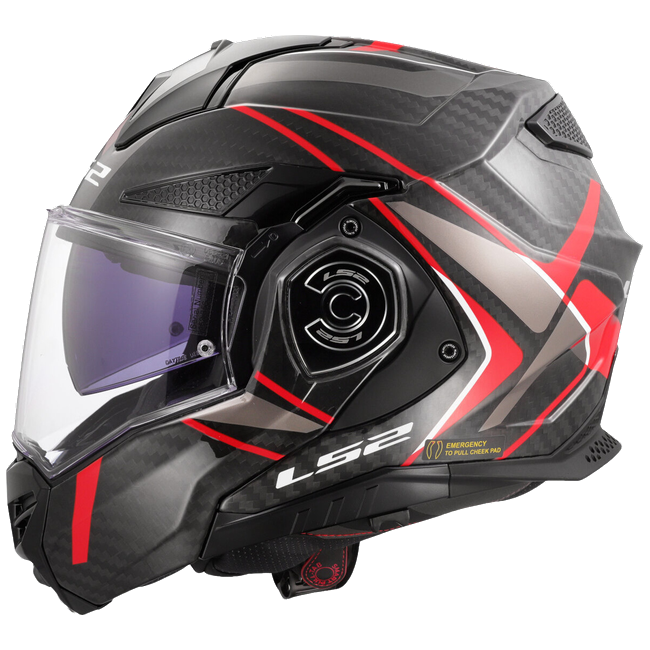
The same faceted Future II geometry, this time in red laid straight onto the bare weave with no white to soften it. Two materials, two states: gloss red where the panels fall, exposed 6K carbon everywhere else. It is the most graphic of the three Future II helmets and the one that reads fastest from a distance.
The chin bar that folds out of the airstream
Almost every flip-up helmet parks its chin bar on top of the head. The Advant X does not: the bar swings back through a full 180 degrees and comes to rest against the back of the shell, low and flat, behind your ears. Watch someone do it once and the reason is obvious — a chin bar sitting up on the crown is a slab of plastic in clean air, and at 100 km/h it lifts, drums and tugs at your neck.
Folded away at the rear it sits in the shell's own wake, where the air is already disturbed. That is what makes riding with the helmet open a genuine option here rather than a car-park convenience: you can leave it open through a town, up a mountain pass, in a queue at a border, and close it again with one gloved hand when the road opens up. The bar is carbon like the rest of the shell, so the mass being swung is small, and the pivot is damped rather than sprung — it travels where you put it instead of slamming.
P and J: one helmet, two homologations
ECE 22.06 P/J is printed on the strap label, and it is worth understanding what you are buying. Modular helmets can be approved in two ways. "P" alone certifies the helmet as protective with the chin bar closed and says nothing about riding it open. "P/J" certifies it twice: once as a full-face with the bar down, once as a jet helmet with the bar rotated back. This helmet holds both.
That has a legal consequence and an engineering one. Legally, riding with the chin bar open is within the approval across the EU rather than a grey area. From an engineering standpoint, the chin bar had to survive the standard's impact and locking tests to earn the P — so the mechanism holding it shut is a certified structure, not a convenience catch.
About the Future II Red finish
Dropping the white changes the whole balance. Without a light base the carbon becomes the field and the red becomes the figure, so the twill is visible across most of the shell instead of between panels — this is the Future II for people who bought a carbon helmet and want it to look like one. The red itself is a saturated gloss, not a metallic, which keeps the facet edges hard against the dark weave and stops the pattern turning muddy in overcast light. On a red or black motorcycle it is close to a factory match; on anything else it is a deliberate contrast rather than an accident. Two things worth knowing: red is the single most-picked helmet colour in this shop, so resale interest is strong, and a predominantly dark shell benefits from the reflective stickers supplied in the box more than a white one does. Apply them.
Carbon 6K — chin bar included
Under the lacquer is 6K carbon twill, and it goes all the way round: crown, sides, rear, and the chin bar. The weave you can see through the clear coat is structural, not a cosmetic layer over fibreglass — a distinction worth making, because "carbon look" helmets exist and this is not one of them.
The engineering case for carbon on a flip-up is stronger than on a full-face. Every modular helmet carries a weight penalty it cannot design away: hinges, a latch, a drop-down sun visor and its housing, and a chin bar that must be stiff enough to certify. Carbon is how you claw that penalty back, and 1550 grams for a P/J flip-up is the evidence that it worked.
What SHARP found, and why we are not claiming it
Worth knowing before you compare this helmet with others: it has no independent safety rating of its own. SHARP lists an "ADVANT X" at four stars from a July 2024 test under ECE 22.06 — perfect fives at every zone at 6.0 and 7.5 m/s, threes at left and right at 8.5 m/s, and the chin bar fully locked in 63 % of impacts — but the helmet on that rig was composite fibre at 1.6 kg.
This one is carbon 6K at 1550 g. Same model name, different shell, and shell construction is precisely the variable SHARP is measuring. Copying the stars across would tell you something we do not actually know. So: certified to ECE 22.06 P/J, no independent star rating, and the composite version's result linked for context. Anyone selling you the carbon Advant X with four SHARP stars attached has not checked. We stock that helmet: it is the LS2 FF901 Advant X in HPFC composite, same chin bar, same P/J approval, 50 g heavier and 70 € cheaper — and it is the one carrying the stars.
What the ECE 22.06 plaque actually means
Every helmet on this page carries ECE 22.06, and it is worth knowing what that plaque now costs a manufacturer. The standard it replaced, 22.05, struck the shell at five fixed points and measured only how hard the head was stopped. 22.06 strikes up to eighteen points, at more than one speed, and adds a test that did not exist before: the helmet is dropped onto an angled anvil faced with abrasive paper, so the laboratory can measure how far the head is spun as well as how hard it is stopped.
That matters because rotational acceleration is what tears the bridging veins between brain and skull, and until 2021 no European standard measured it at all. 22.06 also tests the visor, and any accessory fitted to the helmet is tested in place rather than removed for the exam. Since January 2024 a new helmet cannot legally be sold in the EU without it.
Getting the helmet off a fallen rider
The chin strap closes with a micrometric metal buckle: a toothed tongue that clicks into a sprung catch, adjustable in millimetre increments, releasable with one gloved finger. It is the fastener touring riders ask for, because a helmet that comes on and off twenty times a day should not need a double-D knot each time — and metal rather than plastic is what keeps the adjustment honest over years.
Behind the cheek pads sits the emergency release. Pull tabs let the pads be extracted from the sides while the helmet is still on your head, which is how a trained responder removes a helmet from an unconscious rider with the least movement of the cervical spine. On a modular helmet it is doubly useful — the chin bar can be rotated clear first, and then the pads come out. You will never operate it yourself. That is rather the point.
Three screens, one shell
Vision is where this helmet spends a surprising amount of its budget. The outer screen is scratch-resistant, UV-resistant, wide-aperture and tool-free to change. Behind it is an integrated tinted sun visor that drops with a slider — the part that makes a touring helmet usable when you ride east in the morning and west in the evening. And a fully tinted second outer visor is supplied in the box for days when a drop-down shade is not enough.
The anti-fog insert is a Pinlock 120 MaxVision XLT, supplied rather than offered. It is worth knowing which one, because Pinlock lenses are not interchangeable: this is the XLT cut, part DKS433, and it is listed in the accessories below if you ever need a second. A fogged visor on a modular helmet is a particular nuisance — you can flip the chin bar, but then you are riding open in the rain.
In at two ends, out at the back
The vents are the practical half of this helmet's touring case. Chin intake for the visor and face, crown intake feeding channels moulded into the multi-density EPS, exhaust port at the rear to pull the air through, breath deflector to keep your own breath off the screen. All of it is adjustable and all of it is operable with winter gloves, which is not a given.
The reason the EPS channelling is worth mentioning is that plenty of helmets have vents that lead nowhere. Air enters the shell, meets the polystyrene, and stops. Cutting ducts through the liner foam is the difference between a vent you can feel on your scalp and one you can only see from the outside.
Fit, and the honest word on two shells
Two shell sizes cover seven helmet sizes: XS–L share one shell, XL–3XL the other. That is fewer than the three shells we list on the FF808, FF817 and FF820, and it has a real consequence — a size XS is built on a shell tooled around an L, so it carries more polystyrene than the size needs and looks a little larger on the head than a three-shell helmet would.
The reason is structural rather than cost-cutting. A modular shell has the chin-bar pivot, its locking mechanism and the sun-visor housing moulded into it, so every extra shell size means a substantially more complex and expensive tool. Two shells is the norm right across premium flip-ups. Where it matters is at the extremes: if you take an XS or an S and proportion is important to you, a three- or six-shell full-face will sit closer. Through the middle of the range — M, L and XL, where most riders sit — the difference is academic.
X-Static silver, and laser-cut foam
The liner is finished with X-Static — a fabric with pure silver bonded to the fibre surface. Silver is naturally antimicrobial, so the treatment works on the bacteria that turn a helmet interior sour rather than masking the result, and because the silver is part of the fibre rather than a coating it survives washing. The whole interior is removable and machine-washable, hypoallergenic and breathable.
The cheek pads use laser-cut foam. Cutting with a laser rather than a die lets LS2 vary the density and contour within a single pad, which is how a pad can be firm enough to hold the helmet steady at the jaw and soft enough not to press on the cheekbone. If it ever needs adjusting, cheek pads are available in different thicknesses — the cheapest way to fine-tune a helmet that is otherwise the right size.
Before you buy an intercom
Intercom compatibility, stated honestly: this helmet works with the current LS2 communication system, and the base plate attaches with adhesive rather than a clamp. There is no bracket slot between shell and lining. If you have moved a clamp-mounted unit between helmets before, that habit does not transfer here.
It is worth understanding why rather than treating it as a limitation. Clamp mounts require a machined gap between the shell edge and the cheek pad; on a carbon laminate, cutting that gap introduces a discontinuity in the fibre. LS2's answer was to keep the shell intact and mount on the surface. Speaker recesses and a cable channel are built into the EPS, so the installation itself is tidy — just plan the position of the control unit before you press it down.
On noise
Nobody publishes a decibel figure for this helmet and we are not going to invent one. What can be said is where the noise comes from: turbulence at the base of the shell, air entering under the chin bar, and open vents. A chin curtain is fitted as standard, and it is the single most effective piece of quiet in the box — provided it stays in the helmet after you clean it. The chin bar rotating fully to the rear helps here: a modular bar parked on the crown sits in clean air and drums, while one lying behind the head does not.
The rest is not the helmet's doing. A tall screen that pushes dirty air straight at your head will make any lid loud, and a naked bike at 130 km/h will beat the best-sealed helmet on the market. Earplugs remain the cheapest upgrade in motorcycling.
1550 grams on a flip-up
The scales say 1550 g (±50 g). What makes that figure interesting is the type of helmet it belongs to. Flip-ups pay a structural tax — a hinge mechanism, a locking system, a drop-down sun visor and its housing, and a chin bar stiff enough to be certified as protective. All of it is mass, and most of it is mounted forward of your ears where a lever arm makes it feel heavier than it is.
Carbon 6K in both the shell and the chin bar is how the tax gets paid. The result puts this helmet below most composite full-face touring lids and well below the flip-ups it competes with. Over a day it shows up as neck fatigue you do not have, which is a difficult thing to demonstrate in a shop and an obvious one at the end of a long ride.
Where it sits in our LS2 range
This is the only flip-up in our LS2 line-up, so the comparison below is deliberately cross-type: it shows what the same money buys as a full-face, and what the folding chin bar costs in weight and price. Set against the FF811 Vector II Carbon — same carbon 6K, same manufacturer, 150 grams lighter — the Advant X asks 90 euros more for a chin bar that moves and a second homologation.
| Model | Type | Shell | Weight | RRP |
|---|---|---|---|---|
| FF817 Challenger II | Full-face | HPFC | 1500 g | from 329 € |
| FF811 Vector II Carbon | Full-face | Carbon 6K | 1400 g | from 379 € |
| FF901 Advant X (HPFC) | Flip-up (P/J) | HPFC | 1600 g | from 399 € |
| FF901 Advant X Carbon | Flip-up (P/J) | Carbon 6K | 1550 g | from 469 € |
| FF807 Dragon | Full-face | Carbon 6K | 1450 g | from 479 € |
| FF805 Thunder | Full-face | Carbon | 1280 g | from 599 € |
When something wears out
A helmet is not a sealed unit and the parts that wear are not the shell. Interiors compress, visors scratch, vent covers snap off in a car park. We stock the Advant X liner in every size, cheek pads in several thicknesses, six replacement visors from clear through to iridium gold, the tinted sun visor and its mechanism, plus the carbon chin curtain, complete replacement chin bars in every colourway, the chin-bar ratchet system, pins, plates and chin, top and rear vents in matt or gloss black.
That matters for how long the helmet lasts you. A liner that has taken a summer of sweat is the usual reason a helmet that once fitted starts to move on your head — and replacing it costs a fraction of replacing the helmet. The full parts list is in the FF901 Advant X Kit.
In the box
- LS2 FF901 Advant X Carbon helmet — Future II Red
- Carrying backpack
- Tinted visor
- Pinlock® 120 MaxVision™ XLT anti-fog insert (DKS433)
- Reflective stickers
Specification
- Model — LS2 FF901 Advant X Carbon
- Part number — 569015632
- Colour — Future II Red — Future II graphic, gloss red over carbon
- Homologation — ECE 22.06, dual P/J (protective and jet)
- Helmet type — Flip-up / modular, chin bar rotating 180° to the rear
- Shell — Carbon 6K, chin bar in carbon as well, two shell sizes (XS–L / XL–3XL)
- Weight — 1550 g (±50 g)
- Sizes — XS to 3XL (seven sizes)
- Visor — Twin Visor System, scratch-resistant, UV-stable, quick-release; tinted second visor supplied
- Anti-fog — Pinlock® 120 MaxVision™ XLT (DKS433) supplied
- Sun visor — integrated, tinted, drop-down
- Impact liner — multi-density EPS with moulded ventilation channels
- Retention — micrometric metal buckle, reinforced chin strap, emergency release system
- Ventilation — chin intake, top intake, rear exhaust port, breath deflector
- Liner — X-Static© silver antibacterial, laser-cut foam, hypoallergenic, breathable, removable and washable
- Intercom — prepared for the LS2 intercom — adhesive mount only, no clamp slot
| Model | LS2 FF901 Advant X Carbon |
|---|---|
| Part number | 569015632 |
| Colour | Future II Red — Future II graphic, gloss red over carbon |
| Homologation | ECE 22.06, dual P/J (protective and jet) |
| Helmet type | Flip-up / modular, chin bar rotating 180° to the rear |
| Shell | Carbon 6K, chin bar in carbon as well, two shell sizes (XS–L / XL–3XL) |
| Weight | 1550 g (±50 g) |
| Sizes | XS to 3XL (seven sizes) |
| Visor | Twin Visor System, scratch-resistant, UV-stable, quick-release; tinted second visor supplied |
| Anti-fog | Pinlock® 120 MaxVision™ XLT (DKS433) supplied |
Fitment data coming soon.
No reviews yet.
// LS2
LS2 FF901 Advant X Carbon Future II Red – Flip-Up Touring Helmet ECE 22.06 P/J
Tech specs
- Model
- LS2 FF901 Advant X Carbon
- Part number
- 569015632
- Colour
- Future II Red — Future II graphic, gloss red over carbon
- Homologation
- ECE 22.06, dual P/J (protective and jet)
- Helmet type
- Flip-up / modular, chin bar rotating 180° to the rear
- Shell
- Carbon 6K, chin bar in carbon as well, two shell sizes (XS–L / XL–3XL)
- Weight
- 1550 g (±50 g)
- Sizes
- XS to 3XL (seven sizes)
- Visor
- Twin Visor System, scratch-resistant, UV-stable, quick-release; tinted second visor supplied
- Anti-fog
- Pinlock® 120 MaxVision™ XLT (DKS433) supplied
- Worldwide shipping
- Genuine parts & verified quality
- 14-day returns — in stock ships within 24h
- Personal email support
// Support
Frequently asked questions
Shipping & delivery
Estimate your shipping
Get the real shipping cost for this item to your address — the same rates as checkout.