LS2 FF901 Advant X Carbon Solid Gloss – Flip-Up Touring Helmet ECE 22.06 P/J
Prices for Canada exclude tax · Shipping calculated at checkout
Outside the EU — customs duties and import taxes may apply.
Questions? Just reach out — our team will help you right away.
Size chart LS2 FF901
| Size | Head circumference (cm) | Head circumference (inch) |
|---|---|---|
| XS | 53–54 cm | 20.9–21.3 in |
| S | 55–56 cm | 21.7–22.0 in |
| M | 57–58 cm | 22.4–22.8 in |
| L | 59–60 cm | 23.2–23.6 in |
| XL | 61–62 cm | 24.0–24.4 in |
| XXL | 63–64 cm | 24.8–25.2 in |
| 3XL | 65–66 cm | 25.6–26.0 in |

How to measure your helmet size correctly: To find the right helmet size, measure your head circumference with a flexible tape measure.
It is important that the tape measure runs around the widest part of the head – only then will you get a correct result.
Place the tape measure at the front, about 1–2 cm above the eyebrows, and run it along the sides above the ears.
At the back, the tape must run over the largest part of the back of the head (not too low on the neck). The tape may run slightly at an angle – what matters is that it sits all the way around the largest points of the head.
Make sure the tape measure sits snugly but does not dig in. Measure 2–3 times for the most accurate result. You can then compare the measured value in centimetres (cm) with our size chart.
Tips for an accurate result
- Keep hair flat (e.g. do not measure over a voluminous hairstyle)
- Keep the tape horizontal, i.e. along the largest circumference
- Do not measure too loosely
- For values between two sizes:
→ usually choose the larger size (depending on helmet model / fit)
Important note on fit
The right helmet should fit firmly without causing uncomfortable pressure points.
A new helmet may feel a little tighter at first, as the inner lining adapts slightly over time.
- Worldwide shipping
- Genuine parts & verified quality
- Personal email support
- 14-day returns — in stock ships within 24h
Shipping & Returns
We ship with DHL and FedEx — express on request. If an item is in stock, express delivery can often go out within 1 business day. Standard delivery takes about 2–5 business days domestically and usually around a week worldwide. Please check the available shipping options and delivery times in your cart, as we offer several carriers depending on the country.
Returns must be registered in advance by email and are possible in line with our cancellation policy (14-day return request + 14-day return window after approval). Please note: unregistered returns are not accepted. You'll find all details on conditions, exceptions and refunds in our cancellation policy.
Payment & Security
Payment methods
Your payment information is processed securely. We do not store credit card details and have no access to your credit card information.
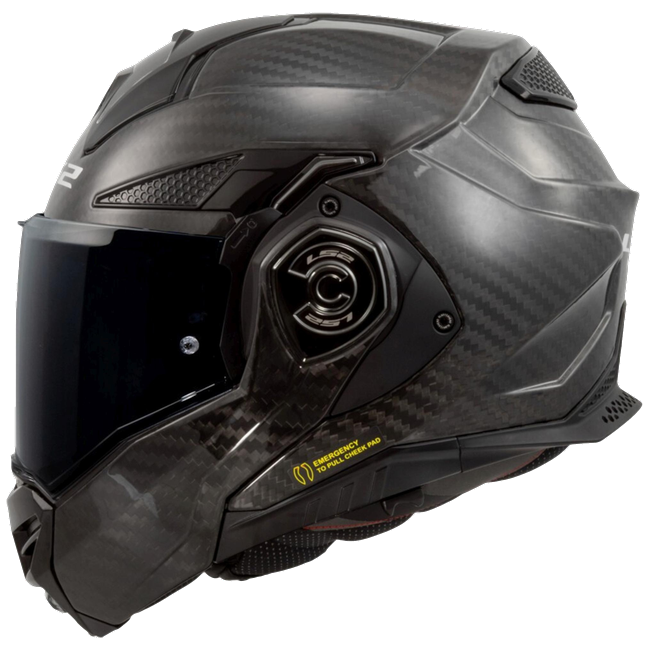
The same bare 6K shell as the matt version, finished under a full gloss clear coat instead. Gloss is what carbon was always photographed in: the lacquer gives the twill depth, so the weave appears to sit a millimetre below the surface rather than on it, and every curve of the shell picks up a highlight.
The chin bar that folds out of the airstream
The single design decision that defines this helmet is where the chin bar goes when you are not using it. LS2 rotates it a full 180 degrees, all the way to the rear of the shell, instead of stopping it on the crown the way most systems do. The difference is aerodynamic and it is not marginal: a chin bar standing proud on top of a helmet is a flat surface presented to oncoming air, and it behaves exactly as you would expect a flat surface to behave.
Tucked behind the head it is out of the airstream almost entirely. The practical result is that open riding stops being something you do at a standstill. The mechanism itself is a two-stage release — one control, deliberate enough that it cannot be brushed open, light enough to work with winter gloves — and the bar is carbon, so there is very little weight travelling over the pivot.
P and J: one helmet, two homologations
Two letters on the label do a lot of work here. ECE 22.06 P/J means this helmet was homologated twice under the same test regime: as a protective full-face with the chin bar closed, and as a jet helmet with it rotated to the rear. Many flip-ups carry only the P, and are approved for closed riding alone.
Combine that with the 180-degree rotation and the helmet does something unusual — it is genuinely two helmets, both of them legal. A full-face for motorway miles and bad weather, an open-face for slow alpine roads, city traffic and hot days, with a five-second transition between them and no need to stop, dismount or carry a second lid.
About the Solid Gloss Carbon finish
Put the two solid carbons side by side and the difference is not subtle. Gloss lacquer refracts light into the weave and back out again, which makes the twill look three-dimensional and gives the checkerboard its characteristic shimmer as you turn the helmet. The shell's shape is more legible too — the chin bar's leading edge, the vent housings and the rear spoiler all catch a line of light that the matt version swallows. Practically: gloss wipes clean in one pass, survives insect season with less scrubbing, and is the finish to choose if the helmet lives on a bike you polish. It also shows fine scratches and cleaning swirls more readily than matt, so a microfibre cloth rather than a garage rag is the price of admission. Of the six, this is the version people notice is carbon from across a car park.
Carbon 6K — chin bar included
Carbon 6K, shell and chin bar alike. The 6K figure describes the cloth — six thousand filaments per tow — which is the weight of weave that resolves into a clean, legible checkerboard rather than the flat grey of finer cloth or the coarse basket of 12K. Under the clear coat it is doing structural work, not decorative work.
The point of specifying carbon on a modular helmet is not prestige, it is compensation. A flip-up starts out heavier than an equivalent full-face by the weight of its mechanism, and the only way back is the shell. LS2 took the shell down to carbon and then took the chin bar down as well, and the result weighs less than most composite full-face touring helmets.
What SHARP found, and why we are not claiming it
SHARP, the UK Department for Transport's independent helmet-testing programme, holds a four-star result for a helmet listed as "ADVANT X", tested in July 2024 against UN ECE Reg 22.06. In the impact tests it scored five out of five at every zone at 6.0 and 7.5 m/s, dropping to three at the left and right zones at 8.5 m/s. The chin bar stayed fully locked in 63 % of impacts.
We are not going to print those stars on this page, and here is why. SHARP records the tested helmet's shell as composite fibre and its mass as 1.6 kg. This helmet has a carbon 6K shell and weighs 1550 g. LS2 builds the Advant X in both materials, and the one SHARP put on the rig was the composite. A different shell material absorbs and distributes impact differently, so transferring the rating would be a guess dressed up as data. If you want the SHARP result, it belongs to the composite Advant X — the link is above, and it is worth reading either way. We stock that helmet: it is the LS2 FF901 Advant X in HPFC composite, same chin bar, same P/J approval, 50 g heavier and 70 € cheaper — and it is the one carrying the stars.
What the ECE 22.06 plaque actually means
ECE 22.06 is not a relabelled 22.05. The old standard hit five marked points on the shell and recorded straight-line deceleration. The current one hits up to eighteen, at multiple speeds, and adds an oblique impact against a slanted, sandpaper-faced anvil — a test designed to measure rotation rather than compression.
Rotation is the injury mechanism European regulation ignored for decades: a glancing blow that twists the head does more damage to the brain than the same energy delivered straight on. 22.06 puts a hard ceiling on it. The visor and any fitted accessory go through the process too, which is why a drop-down sun visor cannot simply be added after approval.
Getting the helmet off a fallen rider
Multi-density EPS sits under the shell — not one uniform block of polystyrene but zones of different densities, firmer where the standard strikes hardest, softer where a low-speed knock needs absorbing. The channels for ventilation are moulded through it rather than cut into it afterwards, which keeps the structure intact. Around it, a reinforced chin strap and a micrometric metal buckle.
The feature that separates this helmet from most of its price class is the emergency release. Cheek pads that can be pulled clear by a first responder let the shell come off an injured rider without the helmet being levered over their head — the single most dangerous moment in a roadside recovery. It costs nothing to have and it is the sort of thing you only think about once.
Three screens, one shell
Count the screens: a clear outer visor fitted, a tinted outer visor in the box, and a drop-down sun visor built into the shell. That is the Twin Visor System plus a spare, and it covers every light condition a rider meets without needing to buy anything. The outer screens are hardcoated, UV-stable, sealed against the shell, and swap over without tools using the quick-release mechanism.
The Pinlock is a 120 MaxVision XLT — top optical grade, edge-to-edge coverage, cut specifically for this visor. Six replacement outer screens are listed for this helmet including three iridium finishes, so the visor is also the cheapest way to change how it looks. Fit the Pinlock before your first cold morning rather than after it.
In at two ends, out at the back
Air enters at two points and leaves at one. A chin intake feeds the back of the visor and your face — the vent that clears a screen on a damp morning. A crown intake feeds channels moulded through the multi-density EPS, so the air travels across your scalp rather than stalling in the gap under the shell. At the back, an exhaust port creates the low-pressure region that makes the whole system move rather than merely exist.
A breath deflector sits behind the chin bar and does one job well: it directs exhaled air downwards instead of up onto the visor. Together with the Pinlock insert, it is why this helmet can be ridden closed in cold rain — which, on a flip-up, is exactly when you least want to be opening the chin bar to breathe.
Fit, and the honest word on two shells
The size run is XS to 3XL across two shells, split XS–L and XL–3XL. We would rather set out what that means than let the spec line pass unexamined: on a two-shell helmet the smallest size is a large shell with thicker EPS inside it. It fits, it is certified, and it looks marginally bigger on a small head than a purpose-tooled shell would.
Flip-ups are built this way almost universally, and the reason is the mechanism. The pivot, the latch and the sun-visor housing are all moulded into the shell, so a third shell size is not a scaled copy but an entirely new tool with all of that geometry re-engineered. LS2 spent the budget on carbon instead. For riders in M through XL it is a non-issue; at the bottom of the range it is worth trying one on.
X-Static silver, and laser-cut foam
Take the interior out — it all comes out — and the construction is visible. X-Static silver-treated fabric against the skin, laser-cut foam beneath it. The silver is antibacterial by nature rather than by additive, which is why the property does not wash out; the laser cutting is what allows density to vary across a single pad instead of being uniform.
In use that means two things. The helmet smells the same after a season as it did in month one, provided you wash the liner occasionally. And the fit is contoured rather than merely padded: firmer where the pad has to locate the helmet on your jaw, more compliant over the cheekbone and temple. Everything is hypoallergenic, breathable, and replaceable in every size.
Before you buy an intercom
A word on communicators, because it changes what you should buy. This helmet mounts an intercom with adhesive only — no clamp slot. The shell is carbon and LS2 has kept it unbroken, which is the right engineering call and an inconvenient one if you like swapping a single unit between two helmets.
Everything else about the installation is well provided for: recesses moulded into the EPS for the speakers so they sit flush rather than pressing on your ears, and a channel for the wiring so nothing runs under the liner in a lump. Take five minutes over the placement, clean the bonding area with alcohol, and let the adhesive cure properly overnight before the first ride.
On noise
Wind noise is the specification manufacturers never quote, because it depends more on your bike than on their helmet. What the helmet controls is the seal at the neck roll, the gap under the chin bar and the vents. A chin curtain is fitted as standard, and it is the single most effective piece of quiet in the box — provided it stays in the helmet after you clean it. The chin bar rotating fully to the rear helps here: a modular bar parked on the crown sits in clean air and drums, while one lying behind the head does not.
What it does not control is the airflow leaving your screen. If a helmet is loud on one motorcycle and quiet on another, the screen is usually the reason. Plugs cost a euro and do more than any shell shape.
1550 grams on a flip-up
1550 grams (±50 g), mid-size shell, no accessories fitted — the standard convention, so the number is directly comparable with any other manufacturer's. Within our own range only the carbon full-face models undercut it, and every one of them achieves that by not having a chin bar that moves.
Convert it into load and the number stops being abstract. Your head is around five kilograms; this adds roughly 30 % to that, and the combined mass sits on a column of vertebrae that absorbs every ripple in the road surface. The difference between 1550 g and the 1700-plus grams of a typical premium flip-up is imperceptible for the first hour and unmistakable by the fifth.
Where it sits in our LS2 range
This is the only flip-up in our LS2 line-up, so the comparison below is deliberately cross-type: it shows what the same money buys as a full-face, and what the folding chin bar costs in weight and price. Set against the FF811 Vector II Carbon — same carbon 6K, same manufacturer, 150 grams lighter — the Advant X asks 90 euros more for a chin bar that moves and a second homologation.
| Model | Type | Shell | Weight | RRP |
|---|---|---|---|---|
| FF817 Challenger II | Full-face | HPFC | 1500 g | from 329 € |
| FF811 Vector II Carbon | Full-face | Carbon 6K | 1400 g | from 379 € |
| FF901 Advant X (HPFC) | Flip-up (P/J) | HPFC | 1600 g | from 399 € |
| FF901 Advant X Carbon | Flip-up (P/J) | Carbon 6K | 1550 g | from 469 € |
| FF807 Dragon | Full-face | Carbon 6K | 1450 g | from 479 € |
| FF805 Thunder | Full-face | Carbon | 1280 g | from 599 € |
When something wears out
Worth knowing before you buy rather than after: everything on this helmet that wears out can be replaced individually. Liners in all seven sizes cheek pads in several thicknesses, six replacement visors from clear through to iridium gold, the tinted sun visor and its mechanism, the carbon chin curtain, complete replacement chin bars in every colourway, the chin-bar ratchet system, pins, plates and chin, top and rear vents in matt or gloss black.
The interior is the part that decides how long the helmet stays honest. Sweat and hair oils break down the foam, the fit loosens, and riders conclude the helmet is finished when the shell is untouched. The full parts list is in the FF901 Advant X Kit.
In the box
- LS2 FF901 Advant X Carbon helmet — Solid Gloss Carbon
- Carrying backpack
- Tinted visor
- Pinlock® 120 MaxVision™ XLT anti-fog insert (DKS433)
- Reflective stickers
Specification
- Model — LS2 FF901 Advant X Carbon
- Part number — 569017099
- Colour — Solid Gloss Carbon — Bare carbon weave, gloss lacquer
- Homologation — ECE 22.06, dual P/J (protective and jet)
- Helmet type — Flip-up / modular, chin bar rotating 180° to the rear
- Shell — Carbon 6K, chin bar in carbon as well, two shell sizes (XS–L / XL–3XL)
- Weight — 1550 g (±50 g)
- Sizes — XS to 3XL (seven sizes)
- Visor — Twin Visor System, scratch-resistant, UV-stable, quick-release; tinted second visor supplied
- Anti-fog — Pinlock® 120 MaxVision™ XLT (DKS433) supplied
- Sun visor — integrated, tinted, drop-down
- Impact liner — multi-density EPS with moulded ventilation channels
- Retention — micrometric metal buckle, reinforced chin strap, emergency release system
- Ventilation — chin intake, top intake, rear exhaust port, breath deflector
- Liner — X-Static© silver antibacterial, laser-cut foam, hypoallergenic, breathable, removable and washable
- Intercom — prepared for the LS2 intercom — adhesive mount only, no clamp slot
| Model | LS2 FF901 Advant X Carbon |
|---|---|
| Part number | 569017099 |
| Colour | Solid Gloss Carbon — Bare carbon weave, gloss lacquer |
| Homologation | ECE 22.06, dual P/J (protective and jet) |
| Helmet type | Flip-up / modular, chin bar rotating 180° to the rear |
| Shell | Carbon 6K, chin bar in carbon as well, two shell sizes (XS–L / XL–3XL) |
| Weight | 1550 g (±50 g) |
| Sizes | XS to 3XL (seven sizes) |
| Visor | Twin Visor System, scratch-resistant, UV-stable, quick-release; tinted second visor supplied |
| Anti-fog | Pinlock® 120 MaxVision™ XLT (DKS433) supplied |
Fitment data coming soon.
No reviews yet.
// LS2
LS2 FF901 Advant X Carbon Solid Gloss – Flip-Up Touring Helmet ECE 22.06 P/J
Tech specs
- Model
- LS2 FF901 Advant X Carbon
- Part number
- 569017099
- Colour
- Solid Gloss Carbon — Bare carbon weave, gloss lacquer
- Homologation
- ECE 22.06, dual P/J (protective and jet)
- Helmet type
- Flip-up / modular, chin bar rotating 180° to the rear
- Shell
- Carbon 6K, chin bar in carbon as well, two shell sizes (XS–L / XL–3XL)
- Weight
- 1550 g (±50 g)
- Sizes
- XS to 3XL (seven sizes)
- Visor
- Twin Visor System, scratch-resistant, UV-stable, quick-release; tinted second visor supplied
- Anti-fog
- Pinlock® 120 MaxVision™ XLT (DKS433) supplied
- Worldwide shipping
- Genuine parts & verified quality
- 14-day returns — in stock ships within 24h
- Personal email support
// Support
Frequently asked questions
Shipping & delivery
Estimate your shipping
Get the real shipping cost for this item to your address — the same rates as checkout.