LS2 FF901 Advant X Solid Matt Black – Flip-Up Touring Helmet ECE 22.06 P/J
Prices for Burkina Faso exclude tax · Shipping calculated at checkout
Outside the EU — customs duties and import taxes may apply.
Questions? Just reach out — our team will help you right away.
Size chart LS2 FF901
| Size | Head circumference (cm) | Head circumference (inch) |
|---|---|---|
| XS | 53–54 cm | 20.9–21.3 in |
| S | 55–56 cm | 21.7–22.0 in |
| M | 57–58 cm | 22.4–22.8 in |
| L | 59–60 cm | 23.2–23.6 in |
| XL | 61–62 cm | 24.0–24.4 in |
| XXL | 63–64 cm | 24.8–25.2 in |
| 3XL | 65–66 cm | 25.6–26.0 in |

How to measure your helmet size correctly: To find the right helmet size, measure your head circumference with a flexible tape measure.
It is important that the tape measure runs around the widest part of the head – only then will you get a correct result.
Place the tape measure at the front, about 1–2 cm above the eyebrows, and run it along the sides above the ears.
At the back, the tape must run over the largest part of the back of the head (not too low on the neck). The tape may run slightly at an angle – what matters is that it sits all the way around the largest points of the head.
Make sure the tape measure sits snugly but does not dig in. Measure 2–3 times for the most accurate result. You can then compare the measured value in centimetres (cm) with our size chart.
Tips for an accurate result
- Keep hair flat (e.g. do not measure over a voluminous hairstyle)
- Keep the tape horizontal, i.e. along the largest circumference
- Do not measure too loosely
- For values between two sizes:
→ usually choose the larger size (depending on helmet model / fit)
Important note on fit
The right helmet should fit firmly without causing uncomfortable pressure points.
A new helmet may feel a little tighter at first, as the inner lining adapts slightly over time.
- Worldwide shipping
- Genuine parts & verified quality
- Personal email support
- 14-day returns — in stock ships within 24h
Shipping & Returns
We ship with DHL and FedEx — express on request. If an item is in stock, express delivery can often go out within 1 business day. Standard delivery takes about 2–5 business days domestically and usually around a week worldwide. Please check the available shipping options and delivery times in your cart, as we offer several carriers depending on the country.
Returns must be registered in advance by email and are possible in line with our cancellation policy (14-day return request + 14-day return window after approval). Please note: unregistered returns are not accepted. You'll find all details on conditions, exceptions and refunds in our cancellation policy.
Payment & Security
Payment methods
Your payment information is processed securely. We do not store credit card details and have no access to your credit card information.
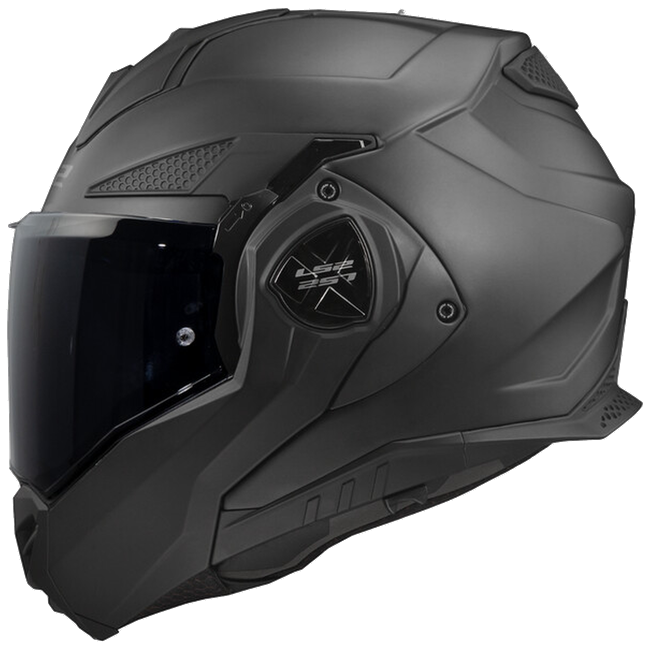
Flat black, no graphic, no gloss. It goes with every motorcycle ever built, draws no attention to itself, and is consistently the best-selling finish of any helmet we list. On the version of the Advant X that carries the SHARP rating, it is the choice for riders who want the result without the livery.
Four stars from SHARP — and this is the helmet they tested
Most helmets on sale have never been independently tested at all. ECE 22.06 is a pass/fail certification — a helmet either meets the threshold or it is not legal — and it tells you nothing about how far above that threshold a given lid sits. SHARP exists to answer that question, and it has answered it for this helmet: four stars out of five, July 2024, tested against ECE 22.06.
The detail matters. Five out of five in all five zones at 6.0 and 7.5 m/s. At 8.5 m/s, five at crown, front and rear; three at left and right. Chin bar fully locked in 63 % of impacts. SHARP logged the shell as composite fibre and the mass as 1.6 kg — HPFC, 1600 g, this helmet. We do not transfer that result to the carbon version, and neither should anyone else.
About the Solid Matt Black finish
There is nothing to clash with and nothing to date. Matt black is the least demanding helmet finish there is — it suits a naked bike, a tourer and a scooter equally, it does not need to be matched to bodywork, and it keeps swirl marks and light scuffing out of sight in a way no gloss coat manages. On a modular helmet that gets handled constantly, that last point is worth more than it sounds. The honest counter-argument is conspicuity. Black is the least visible colour on the road, and the gap is widest exactly when it matters most: dusk, rain and the grey light of a winter afternoon. That is what the reflective stickers in the box are for, and on this finish they are not a nice-to-have — apply them to the rear and the sides, where a driver's headlights will actually find them.
A chin bar that folds out of the airstream
The chin bar does not stop on top of your head. It carries on through a full 180 degrees until it lies flat against the back of the shell, below ear level. That single difference is what separates a flip-up you open at the pumps from one you can ride open for an hour: a bar parked on the crown stands in undisturbed air and behaves like the flat plate it is, lifting and drumming from about 80 km/h upwards.
Stowed at the rear it sits inside the shell's own turbulent wake, where there is very little left to disturb. The release is a single control with a firm detent — deliberate enough that a glove brushing past will not open it, light enough to work one-handed at a junction. Closing it is the same movement in reverse, and the bar does not slam.
P and J: two homologations on one label
P/J is what turns a folding chin bar into a second helmet rather than a party trick. Under ECE 22.06 a modular helmet can be homologated as protective ("P"), as a jet helmet ("J"), or as both. This one carries both approvals, which is why riding it with the chin bar stowed is within the certification across the EU rather than a grey area you hope nobody asks about.
There is an engineering reading of the same fact. To earn the P, the chin bar had to survive the standard's impact and locking tests — so the mechanism holding it shut is a certified structure rather than a convenience catch. SHARP measured the same thing independently and found it fully locked in 63 % of impacts.
HPFC — what the shell is actually made of
The shell is HPFC — LS2's high-performance fibre composite, hand-laid rather than injection-moulded. In the LS2 hierarchy it sits above the KPA and HPTT thermoplastics used on the entry-level models and below the carbon 6K of the Advant X Carbon, and it is the material LS2 uses on its touring full-face helmets too.
What a composite gives you is stiffness per gram and, more usefully on a modular helmet, the ability to reinforce specific regions. The Advant X shell is interrupted in three places — pivot, latch and sun-visor housing — and every one of those interruptions has to survive the standard. Fibre laid around them is how that is done.
What the ECE 22.06 plaque actually means
ECE 22.06 is not a relabelled 22.05. The old standard hit five marked points on the shell and recorded straight-line deceleration. The current one hits up to eighteen, at multiple speeds, and adds an oblique impact against a slanted, sandpaper-faced anvil — a test designed to measure rotation rather than compression.
Rotation is the injury mechanism European regulation ignored for decades: a glancing blow that twists the head does more damage to the brain than the same energy delivered straight on. 22.06 puts a hard ceiling on it. The visor and any fitted accessory go through the process too, which is why a drop-down sun visor cannot simply be added after approval.
The tabs a paramedic looks for
A modular helmet has a joint where a full-face has none, and ECE 22.06 tests that joint: the chin bar must stay locked when the helmet is struck. SHARP measured the same property independently and recorded it fully locked through 63 % of impacts — a number you can weigh, rather than a reassurance you have to take on trust.
Beyond the joint, the specification is multi-density EPS with moulded-in ventilation channels, a reinforced chin strap, a micrometric buckle with a metal ratchet, and an emergency release on the cheek pads that lets a paramedic take the helmet off without rotating your neck.
Three screens, one shell
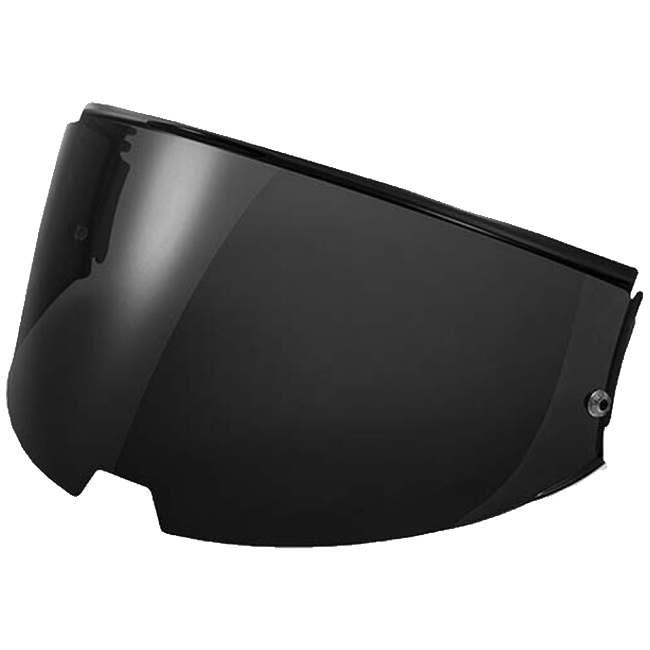
Three screens come with this helmet. A clear outer visor is fitted: scratch-resistant hardcoat, UV-stable, wide aperture, quick-release so it changes without tools. A second outer visor, already tinted, is in the box — the part most manufacturers sell separately for around fifty euros. And behind the outer screen sits a drop-down sun visor on a slider, which LS2 calls the Twin Visor System.
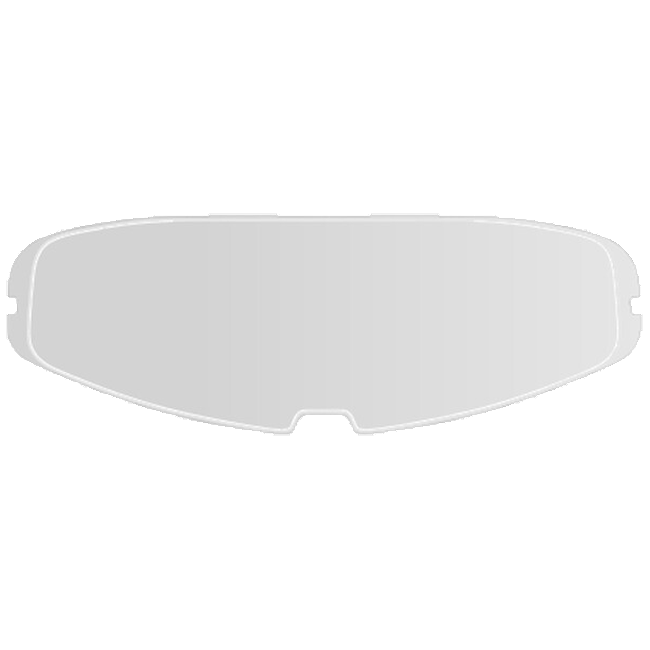
A Pinlock® 120 MaxVision™ XLT insert is supplied as well. Each part of that name means something: 120 is Pinlock's highest optical class, MaxVision is the wide cut that reaches the edges of the aperture instead of leaving a frame in your vision, and XLT is the size made for this visor. On a flip-up ridden through winter, an anti-fog insert is not an accessory.
In at two ends, out at the back
Chin intake, crown intake, rear exhaust, breath deflector. What separates this from a token system is the polystyrene: the channels are moulded into the EPS rather than relying on the gap between liner and shell, so incoming air is guided over the head instead of dispersing. Without the rear outlet none of it would move — an intake with no exhaust is just a hole.
Realistic expectations are worth setting. No modular helmet ventilates like a vented sports full-face, because the pivot, latch and sun-visor housing occupy volume that would otherwise be duct. What this system does well is the touring case: steady airflow at road speed, a visor that stays clear in the cold, and the option of simply rotating the chin bar away in summer traffic.
Fit, and the honest word on two shells
Two shells, seven sizes, split at XL. Compared with the three shells on the FF808, FF817 and FF820 that is coarser, and the effect lands on the small sizes — an XS carries the same shell as an L with extra polystyrene making up the difference.
It is a trade every modular helmet makes, because the chin-bar pivot, the locking mechanism and the sun-visor housing are moulded into the shell itself. What you get in exchange here is a composite shell with an independent four-star rating rather than a third tool. Riders in the middle of the range will not notice; riders at the very bottom should try one on.
The liner, and one claim we are not making
Take the interior out — it all comes out — and the construction is visible: laser-cut foam under a breathable, hypoallergenic fabric, held in with press studs and tongues rather than glue. Everything is machine-washable, which on a helmet ridden through summer is not optional.
An honest note on the specification. The Advant X Carbon's liner carries an X-Static silver antibacterial finish; this composite version's does not, and LS2 does not claim it. What that changes in practice is how quickly the interior starts to smell if it is never washed. What it does not change is the fit, the safety rating or the fact that the whole set is a replaceable part.
Before you buy an intercom
Before you order a communicator, read this. The Advant X takes its intercom by adhesive mount only — there is no clamp slot between the shell and the cheek pad for a bracket to slide into. LS2 states it explicitly, and it is better known before the parcel arrives than after.
What the helmet does provide is proper preparation: shaped speaker pockets in the EPS so the drivers sit flush rather than pressing on your ears, and a routing channel for the loom. Installation is straightforward, it is simply permanent. Dry-fit the unit against the helmet on your head first to check the button reaches your thumb, degrease the shell with isopropyl alcohol, bond it and leave it overnight.
On noise
Nobody publishes a decibel figure for this helmet and we are not going to invent one. What can be said is where the noise comes from: turbulence at the base of the shell, air entering under the chin bar, and open vents. A chin curtain is fitted as standard, and it is the single most effective piece of quiet in the box — provided it stays in the helmet after you clean it. The 180-degree chin bar helps here: a modular bar parked on the crown sits in clean air and drums, while one lying flat behind the head does not.
The rest is not the helmet's doing. A tall screen that pushes dirty air straight at your head will make any lid loud, and a naked bike at 130 km/h will beat the best-sealed helmet on the market. Earplugs remain the cheapest upgrade in motorcycling.
1600 grams on a flip-up
1600 grams, ±50, measured the way the industry measures: a mid-size shell with nothing fitted to it. Read that against other flip-ups rather than against full-face helmets. A modular helmet carries a hinge, a latch, an internal sun visor with its housing, and a chin bar stiff enough to be certified as protective — the premium P/J touring flip-ups riders cross-shop this against generally sit between 1650 and 1800 grams.
Convert it into load and it stops being abstract. A head weighs about five kilograms; this adds roughly a third again, and every expansion joint on the motorway multiplies the total through your neck. If 50 grams matters to you, the Advant X Carbon is 1550 g — and 70 euros more.
Carbon or composite? A straight answer
Two Advant X models sit side by side in this shop and they are not the same helmet under the paint. This is the composite: HPFC shell, 1600 g, from 399 €. The carbon is carbon 6K in both shell and chin bar, 1550 g, from 469 €, and carries an X-Static silver antibacterial liner this one does not.
The decisive difference is not weight, it is evidence. SHARP tested a composite-fibre Advant X at 1.6 kg — this helmet — and gave it four stars out of five. That result belongs to this shell and we do not transfer it to the carbon. Anyone advertising the carbon Advant X with four SHARP stars attached has not checked which helmet was on the rig.
Where it sits in our LS2 range
Two flip-ups and three full-face models frame this helmet in our LS2 line-up. Read the table for what the folding chin bar costs against a comparable composite full-face, and what the carbon Advant X costs above it.
| Model | Type | Shell | Weight | RRP |
|---|---|---|---|---|
| FF818 Storm III | Full-face | KPA | 1600 g | from 199 € |
| FF811 Vector II | Full-face | HPFC | 1500 g | from 259 € |
| FF817 Challenger II | Full-face | HPFC | 1500 g | from 329 € |
| FF901 Advant X | Flip-up (P/J) | HPFC | 1600 g | from 399 € |
| FF901 Advant X Carbon | Flip-up (P/J) | Carbon 6K | 1550 g | from 469 € |
When something wears out
A helmet is not a sealed unit and the parts that wear are not the shell. Interiors compress, visors scratch, vent covers snap off in a car park. We stock the Advant X liner in every size, cheek pads, six replacement visors from clear through to iridium gold, the tinted sun visor and its mechanism, plus complete replacement chin bars in every colourway, chin, top and rear vents in matching finishes, ratchet plates, pins and the chin curtain.
That matters for how long the helmet lasts you. A liner that has taken a summer of sweat is the usual reason a helmet that once fitted starts to move on your head — and replacing it costs a fraction of replacing the helmet. The full parts list is in the FF901 Advant X Kit.
In the box
- LS2 FF901 Advant X helmet — Solid Matt Black
- Carrying backpack
- Tinted visor
- Pinlock® 120 MaxVision™ XLT anti-fog insert (DKS433)
- Reflective stickers
Specification
- Model — LS2 FF901 Advant X
- Part number — 569011011
- Colour — Solid Matt Black — Solid black, matt
- Homologation — ECE 22.06, dual P/J (protective and jet)
- Safety rating — SHARP 4 of 5 stars (tested July 2024, ECE 22.06)
- Helmet type — Flip-up / modular, chin bar rotating 180° to the rear
- Shell — HPFC fibre composite, two shell sizes (XS–L / XL–3XL)
- Weight — 1600 g (±50 g)
- Sizes — XS to 3XL (seven sizes)
- Anti-fog — Pinlock® 120 MaxVision™ XLT (DKS433) supplied
- Visor — Twin Visor System, scratch-resistant, UV-stable, quick-release; tinted second visor supplied
- Sun visor — integrated, tinted, drop-down
- Impact liner — multi-density EPS with moulded ventilation channels
- Retention — micrometric metal buckle, reinforced chin strap, emergency release system
- Ventilation — chin intake, top intake, rear exhaust port, breath deflector
- Liner — laser-cut foam, hypoallergenic, breathable, removable and washable (no antibacterial treatment specified)
- Intercom — prepared for the LS2 intercom — adhesive mount only, no clamp slot
| Model | LS2 FF901 Advant X |
|---|---|
| Part number | 569011011 |
| Colour | Solid Matt Black — Solid black, matt |
| Homologation | ECE 22.06, dual P/J (protective and jet) |
| Safety rating | SHARP 4 of 5 stars (tested July 2024, ECE 22.06) |
| Helmet type | Flip-up / modular, chin bar rotating 180° to the rear |
| Shell | HPFC fibre composite, two shell sizes (XS–L / XL–3XL) |
| Weight | 1600 g (±50 g) |
| Sizes | XS to 3XL (seven sizes) |
| Anti-fog | Pinlock® 120 MaxVision™ XLT (DKS433) supplied |
-
1× helmet
-
Carrying backpack
-
Tinted visor
-
Pinlock® 120 MaxVision™ XLT anti-fog insert (DKS433)
-
Reflective stickers
Fitment data coming soon.
No reviews yet.
Build your kit
Gear up your FF901 Advant X.
Add the parts made for this helmet — your total updates live.
 Built-in sun visor
Included
Built-in sun visor
Included
 LS2 Pinlock 120 MaxVision XLT Insert DKS433
Included free
LS2 Pinlock 120 MaxVision XLT Insert DKS433
Included free
helmet only
Your helmet is always included · anything marked Included already comes with it · pick your size in the buy box above
// LS2
LS2 FF901 Advant X Solid Matt Black – Flip-Up Touring Helmet ECE 22.06 P/J
Tech specs
- Model
- LS2 FF901 Advant X
- Part number
- 569011011
- Colour
- Solid Matt Black — Solid black, matt
- Homologation
- ECE 22.06, dual P/J (protective and jet)
- Safety rating
- SHARP 4 of 5 stars (tested July 2024, ECE 22.06)
- Helmet type
- Flip-up / modular, chin bar rotating 180° to the rear
- Shell
- HPFC fibre composite, two shell sizes (XS–L / XL–3XL)
- Weight
- 1600 g (±50 g)
- Sizes
- XS to 3XL (seven sizes)
- Anti-fog
- Pinlock® 120 MaxVision™ XLT (DKS433) supplied
// Support
Frequently asked questions
Shipping & delivery
Estimate your shipping
Get the real shipping cost for this item to your address — the same rates as checkout.